supportuae@vinstreak.com
 +971 52 279 7715


Transfer Pricing UAE: Master File, Local File & Disclosure Guide
Transfer Pricing UAE rules apply to businesses that transact with Related Parties and Connected Persons, whether those parties are in the UAE mainland, a free zone or outside the UAE. The purpose is to prove that pricing follows the arm’s length principle. This guide explains when UAE groups should prepare transfer pricing documentation, how to structure the Master File and Local File, what data to collect for benchmarking, how to draft intercompany agreements and how to align the numbers with Corporate Tax and EmaraTax disclosures.
Who Should Review?
UAE entities with management fees, intercompany services, loans, royalties, guarantees, cost recharges, goods trading or transactions with owners/connected persons.
Core Principle
Related party prices must be comparable to prices that independent parties would agree under similar circumstances.
SME Relief Note
Small Business Relief can remove TP documentation requirement, but the arm’s length principle still applies.
Internal Support
Connect Corporate Tax, Accounting, Virtual CFO and Internal Audit.
1) Related-party transactions and documentation triggers
Start by mapping transactions with Related Parties and Connected Persons. The FTA confirms that UAE transfer pricing rules apply to both domestic and cross-border transactions, including arrangements with related parties in the mainland, free zones and foreign jurisdictions.
- Identify owners, directors, key management, family relationships, group companies, sister concerns and foreign affiliates.
- Quantify transactions: goods, services, management fees, royalties, loans, guarantees, cost allocations, rent, assets and reimbursements.
- Check whether Master File, Local File, disclosure form, related party schedule or connected person schedule is required.
- Keep minimum support even for smaller transactions: agreement, invoice, calculation, approval and business rationale.
2) Master File vs Local File: what each document should prove
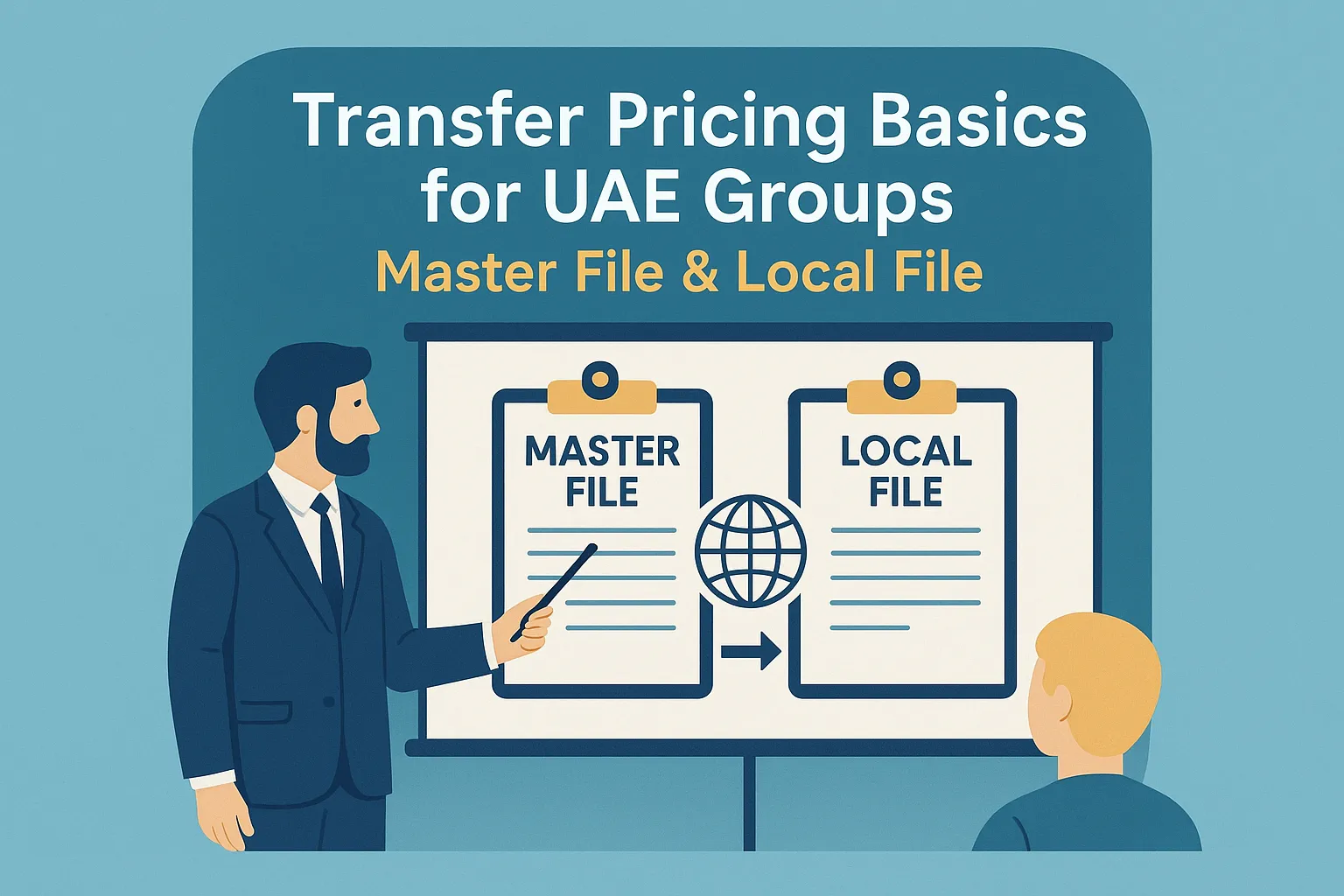
The Master File explains the wider group, while the Local File defends the UAE entity’s controlled transactions. The documents should reconcile with financial statements, trial balance, invoices and Corporate Tax return positions.
- Master File: group structure, supply chain, value drivers, intangibles, financing, transfer pricing policies and business overview.
- Local File: UAE entity profile, transaction details, related party amounts, FAR analysis, method selection, tested party, benchmarking and financial testing.
- Appendices: intercompany agreements, invoices, reconciliations, segmented P&L, allocation keys and management approvals.
- Use the same transaction labels in accounting, tax return, Local File and agreements.
3) FAR analysis: functions, assets and risks
A good transfer pricing file does not start with a benchmark. It starts with the business model. FAR analysis explains who performs the functions, who owns/uses assets and who controls and bears risks.
- Functions: sales, procurement, logistics, management, R&D, marketing, finance, administration and support services.
- Assets: inventory, fixed assets, people, systems, contracts, licences, brands and intangibles.
- Risks: market risk, credit risk, inventory risk, product risk, foreign exchange risk and capacity risk.
- Link FAR conclusions to the selected transfer pricing method and profit level indicator.
4) Method selection, tested party and benchmarking study
The transfer pricing method should match the transaction and available comparable data. UAE guidance recognises OECD-style methods including CUP, Resale Price, Cost Plus, TNMM and Profit Split. Domestic comparables are preferred where reliable, but non-domestic comparables may be used when local data is insufficient.
- Choose the tested party, usually the simpler entity with reliable financial data.
- Select method and profit level indicator: gross margin, net margin, cost-plus mark-up, interest rate or royalty rate as appropriate.
- Apply database screening, accept/reject criteria and interquartile range analysis.
- Compare actual results with the benchmark and document true-up or adjustment logic if required.
5) Intercompany agreements and invoicing hygiene
A transfer pricing report is weak if the legal contracts and invoices say something different. Intercompany agreements should match the FAR analysis, pricing policy, accounting treatment and actual conduct.
- Draft agreements before or during the transaction period, not only after year-end.
- Include scope, parties, pricing formula, payment terms, IP clauses, responsibilities, termination and supporting evidence.
- Avoid vague year-end management-fee invoices without calculation or benefit evidence.
- Reconcile invoices, ledgers, withholding tax/treaty positions abroad and VAT treatment where applicable.
6) 30-day UAE transfer pricing readiness sprint
Use this sprint to build a practical TP file before Corporate Tax filing or before the next audit request.
- Week 1: Related-party map, connected person list, transaction register and agreement collection.
- Week 2: Segmented P&L, trial balance reconciliation, invoice sampling, allocation keys and service-benefit evidence.
- Week 3: FAR interviews, method selection, tested party decision and benchmarking data request.
- Week 4: Draft TP policy, Master/Local File outline, intercompany agreement fixes and management sign-off.
Common UAE Transfer Pricing mistakes and fixes
- No related-party transaction register — Fix: maintain a monthly register with party, amount, nature, contract and ledger code.
- One blended margin for different business lines — Fix: create segmented P&L by function, product or entity where material.
- Management fees without benefit evidence — Fix: keep service descriptions, deliverables, time records, allocation keys and approvals.
- Agreements do not match actual conduct — Fix: update agreements and invoices to match FAR analysis and TP policy.
- Benchmarking not linked to financials — Fix: reconcile benchmark-tested margin to audited or management accounts.
 18 September 2025